

Overall Rating: 8.5/10
At some point, many travelers quietly stop enjoying hotels.
The rooms feel repetitive.
The walls feel thin.
The experience feels transactional.
And after enough trips, people start wanting something hotels often fail to provide:
Space that actually feels livable.
That’s where platforms like Vrbo enter the conversation.
But Vrbo occupies an interesting position in the vacation-rental market.
It’s not as culturally dominant as Airbnb.
It’s not as hotel-focused as Booking.com.
And it doesn’t aggressively market itself with lifestyle branding the way many travel companies do.
Instead, Vrbo mostly focuses on one thing:
entire vacation homes.
That single decision changes the entire platform experience.
This review is written from the perspective of travelers who:
- prioritize comfort over trendiness,
- travel with families or groups,
- and increasingly want travel accommodations to feel less chaotic.
Because honestly, many people are exhausted with modern travel platforms constantly turning every trip into a gamble.
Vrbo Feels Less Like “Travel Culture” and More Like Practical Vacation Planning


One thing immediately stands out when using Vrbo:
The platform feels more practical than performative.
Airbnb often feels heavily optimized for:
- aesthetic uniqueness,
- social-media appeal,
- quirky stays,
- tiny homes,
- design-first experiences.
Vrbo feels more focused on:
- usable houses,
- family trips,
- beach rentals,
- ski cabins,
- multi-bedroom spaces,
- and long-stay comfort.
That distinction matters.
Because many travelers eventually stop caring about “Instagram-worthy stays” and start caring about:
- functioning kitchens,
- privacy,
- parking,
- laundry,
- and whether eight people can sleep comfortably without fighting.
Vrbo understands that audience surprisingly well.
The “Entire Property Only” Philosophy Is a Huge Advantage
This is arguably Vrbo’s biggest strength.
Unlike Airbnb, Vrbo heavily emphasizes entire-home rentals rather than:
- shared spaces,
- private room rentals,
- or host-living-on-site situations.
That creates a very different psychological experience.
Travelers usually feel:
- more relaxed,
- more private,
- less socially awkward,
- and less worried about house-rule micromanagement.
Because honestly, one of the strangest evolutions of Airbnb culture was turning travelers into temporary roommates.
Many people quietly hated that experience.
Vrbo largely avoids it.
That alone makes the platform extremely attractive for:
- families,
- groups,
- older travelers,
- and people who simply want peace during vacations.
Vrbo Works Best for Group Economics


Vacation rentals become dramatically more cost-effective when split across multiple people.
This is where Vrbo performs extremely well.
A large house with:
- four bedrooms,
- kitchen access,
- living space,
- parking,
- laundry,
- and outdoor areas
often becomes cheaper per person than booking multiple hotel rooms.
Especially in:
- beach destinations,
- ski towns,
- family vacation spots,
- and suburban travel areas.
Vrbo quietly dominates these use cases.
The platform makes far less sense for solo travelers or quick city trips.
But for group vacations?
The economics become compelling quickly.
The Search Experience Feels More Stable Than Airbnb
This is subtle but important.
Airbnb increasingly feels algorithmically chaotic.
Listings constantly shift visibility.
Pricing changes aggressively.
Cleaning fees can become absurd.
And the platform often feels optimized around engagement rather than clarity.
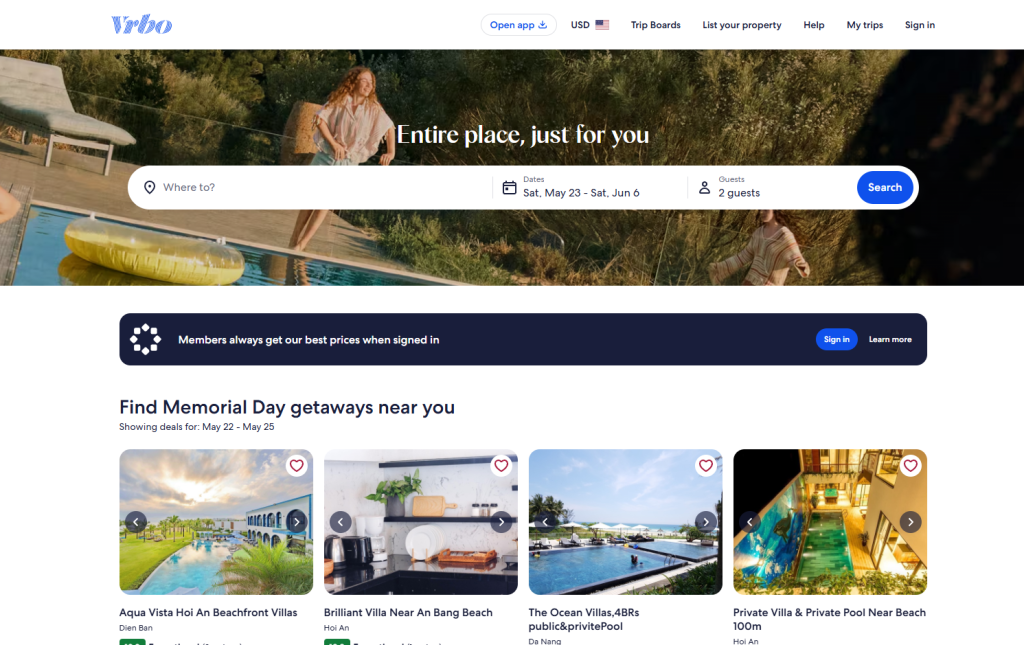
Vrbo feels calmer.
The interface:
- emphasizes property details,
- surfaces family-oriented features,
- and generally creates less decision fatigue.
No, it isn’t revolutionary UX design.
But it feels less manipulative.
That’s increasingly rare online.
The Biggest Problem With Vrbo Is the Same Problem Facing All Vacation Rental Platforms


Here’s the uncomfortable truth:
Vacation rental platforms are only as good as the individual property owners.
That means experiences vary massively.
You can book:
- a beautiful perfectly managed home,
or - a poorly maintained disaster with misleading photos.
Vrbo cannot fully standardize human quality control.
And that inconsistency remains the biggest weakness of the entire short-term rental industry.
Some common complaints across Vrbo properties include:
- surprise cleaning expectations,
- inaccurate listing photos,
- weak communication,
- maintenance issues,
- or inconsistent cleanliness.
To Vrbo’s credit, this is not uniquely their problem.
It’s structural to the business model itself.
Vrbo Feels More “Adult” Than Airbnb
This may sound strange, but many travelers understand exactly what this means.
Airbnb increasingly feels optimized for:
- digital nomads,
- influencer aesthetics,
- trendy experiences,
- and younger travelers seeking novelty.
Vrbo feels more aligned with:
- parents,
- families,
- reunions,
- retirement-age travelers,
- and people prioritizing comfort over social identity.
The platform feels less obsessed with branding lifestyle fantasies.
Instead, it focuses heavily on functionality.
That’s one reason many older travelers strongly prefer it.
Customer Service Still Feels Like a Weak Spot


This is one area where Vrbo still receives heavy criticism.
Like many travel platforms, customer support quality becomes unpredictable during serious disputes.
Especially involving:
- cancellations,
- refunds,
- misleading listings,
- or property-condition disagreements.
Some travelers report smooth resolutions.
Others describe exhausting support loops between:
- property owners,
- Vrbo,
- and payment systems.
This problem exists across nearly every major booking platform today.
But it matters more with vacation rentals because the financial stakes are often larger.
Families booking week-long stays can easily spend thousands upfront.
When problems happen, frustration escalates quickly.
Cleaning Fees Still Hurt the Experience
This issue affects the entire industry.
Many travelers now experience “cleaning fee fatigue.”
A property appears affordable initially.
Then:
- cleaning fees,
- service fees,
- occupancy taxes,
- and checkout instructions
suddenly transform the economics.
Vrbo is not immune to this problem.
Sometimes total pricing feels surprisingly high compared to hotels — especially for short stays.
The platform works best when:
- stays are longer,
- groups split costs,
- or travelers fully utilize the home features.
For one-night or two-night trips, hotels often remain more practical.
Vrbo Is Excellent for Slow Travel


This is where Vrbo becomes genuinely valuable.
The platform supports a style of travel that feels slower and more livable.
Instead of:
- rushing through hotel corridors,
- eating every meal outside,
- and constantly living out of suitcases,
travelers can:
- cook,
- spread out,
- work remotely,
- do laundry,
- and settle into locations more naturally.
That experience becomes especially attractive for:
- families with children,
- remote workers,
- multi-week travelers,
- and people burned out by traditional tourism rhythms.
Vrbo quietly excels here.
Who Vrbo Is NOT Ideal For
Vrbo may not fit travelers who:
- take very short trips,
- travel solo frequently,
- prioritize luxury hotel service,
- or want highly standardized experiences.
Hotels still outperform vacation rentals in:
- consistency,
- immediate support,
- daily housekeeping,
- and convenience.
Vrbo requires more tolerance for variability.
Some travelers hate that uncertainty.
Who Vrbo Fits Perfectly
Vrbo works extremely well for:
- family vacations,
- beach trips,
- ski trips,
- group travel,
- long stays,
- and travelers wanting more private, livable spaces.
Especially people who think:
“I want travel to feel less cramped and less transactional.”
That’s where Vrbo becomes genuinely compelling.
Final Verdict: Vrbo Succeeds Because Many Travelers No Longer Want Hotels for Every Trip


Vrbo understands something important about modern travel:
Many people no longer want vacations that feel industrialized.
They want:
- space,
- privacy,
- flexibility,
- kitchens,
- comfort,
- and environments that feel temporarily livable.
That’s exactly what Vrbo delivers at its best.
The platform is not perfect.
Customer support inconsistency remains real.
Cleaning fees remain frustrating.
And property quality still depends heavily on hosts.
But for travelers prioritizing group comfort and real living space over hotel uniformity?
Vrbo remains one of the strongest vacation rental platforms available today.
Detailed Scorecard
| Category | Score |
|---|---|
| Family Travel Experience | 9.2/10 |
| Group Value | 9.1/10 |
| Privacy & Comfort | 9.0/10 |
| Ease of Booking | 8.3/10 |
| Customer Support | 7.0/10 |
| Property Consistency | 7.5/10 |
| Long-Stay Suitability | 9.1/10 |
| Pricing Transparency | 7.4/10 |
| Hotel Alternative Value | 8.8/10 |
| Overall Rating | 8.5/10 |
Disclaimer
Vacation rental experiences vary significantly depending on property owners, locations, seasonal demand, and individual expectations. Pricing, fees, cancellation policies, and amenities may change over time. Travelers should carefully review listing details, house rules, total pricing, and recent guest reviews before booking.