

Buying a PONGBOT tennis ball machine is less straightforward than it looks, because the brand sells eight machines under one name and four of them are not tennis machines at all. This guide lays out the whole line, the current prices in US dollars, the published specifications, and the three places where the store is quieter than it could be about what a PONGBOT tennis ball machine actually gives you.
Everything below was read from the public PONGBOT store on 22 October 2026 with the storefront currency set to USD. Nothing was bought and no PONGBOT tennis ball machine was tested on court; this is a desk review of what the company publishes. The full PONGBOT tennis ball machine range is listed on the official store, and the figures in this article are a snapshot of that page.
What the PONGBOT tennis ball machine range actually includes
PONGBOT is best known as the Official Ball Machine of the Australian Open, a partnership the company states on its own homepage along with Official Ball Machine Supplier of the National Tennis Academy. Those are company claims rather than independently verified facts, and this review treats them as such.
The important structural point for anyone shopping for a PONGBOT tennis ball machine is that the catalogue splits cleanly in two, and the store does not label the split clearly on the homepage.
| Family | Models | Weight | Ball capacity |
| Tennis ball machines | Pace S · Pace S Pro · AO Pace S Pro · Aura | 7–22 kg | 150 balls |
| Table tennis robots | Nova S Pro · Omni S Plus · Omni S Pro · Halo S Pro | 9–11 kg | 250 balls |
If you are shopping for a PONGBOT tennis ball machine for a court, only the first row matters. The second row sits on a table and fires 40 mm plastic balls across a net two and a half metres away. Both families share branding, app language and the word “robot”, so it is worth checking the product page twice before you pay.
Every PONGBOT tennis ball machine price, in one table
Every PONGBOT tennis ball machine and every table tennis robot in the catalogue is listed below at the current sale price alongside the list price the store shows struck through. The sale is running from 20 October to 6 December 2026, so treat these as a snapshot rather than permanent figures.
| Model | Family | Sale price | List price | Discount |
| Nova S Pro | Table tennis | 299.99 USD | 399.99 USD | 25% |
| Aura | Tennis / multi-sport | 599.99 USD | 1,199.99 USD | 50% |
| Omni S Plus | Table tennis | 699.99 USD | 1,199.99 USD | 42% |
| Pace S | Tennis | 999.99 USD | 1,699.99 USD | 41% |
| Pace S Pro | Tennis | 1,219.99 USD | 1,999.99 USD | 39% |
| Omni S Pro | Table tennis | 1,299.99 USD | 1,599.99 USD | 19% |
| AO Pace S Pro | Tennis | 1,599.99 USD | 2,599.99 USD | 38% |
| Halo S Pro | Table tennis | 1,599.99 USD | 1,999.99 USD | 20% |
Read down the discount column and a pattern appears that the store never points out: the deepest cuts on a PONGBOT tennis ball machine are on the two newest and the two cheapest products, while the flagship table tennis robot and the premium Omni are barely discounted at all. Current PONGBOT tennis ball machine prices are on the store and move during the sale window.
The 55 per cent claim and the real PONGBOT tennis ball machine discount
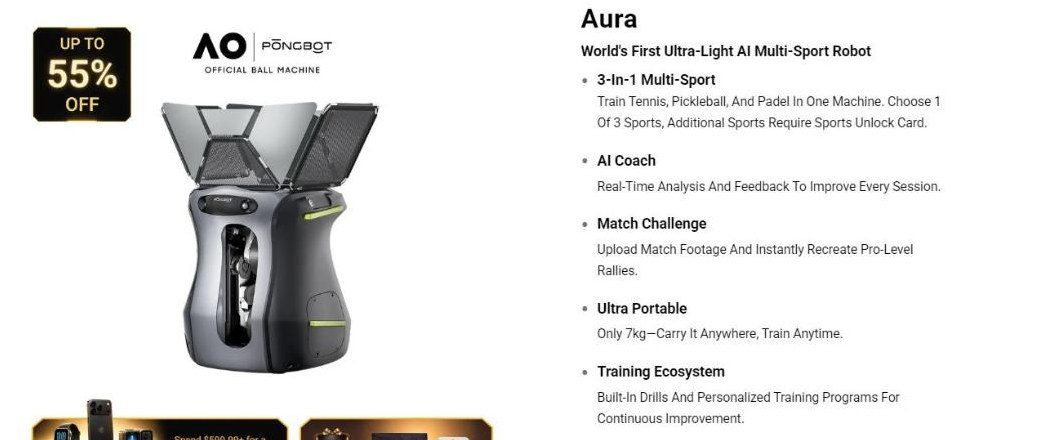
The sale badge on the site reads UP TO 55% OFF. Working through every product page and the accessories collection on 22 October 2026, the deepest discount this review could find was 50%, on the Aura at 599.99 from 1,199.99 US dollars. The best accessory discount was 43%, on the Pace spare battery.
Both figures are published by the company, and this review reports them side by side without resolving them. A 55% tier may apply to a bundle, to a later phase of the sale, or to a product not listed when this was checked. The practical point for anyone budgeting is to work from the PONGBOT tennis ball machine price on the product page rather than from the banner.
Pace S or Pace S Pro: where the 220 dollars goes
Two machines sit at the centre of the PONGBOT tennis ball machine line, and the gap between them is the single most useful thing to understand before ordering.
This is the comparison most buyers will actually face, and it is the one worth doing carefully, because the two machines publish identical PONGBOT tennis ball machine hardware specifications.
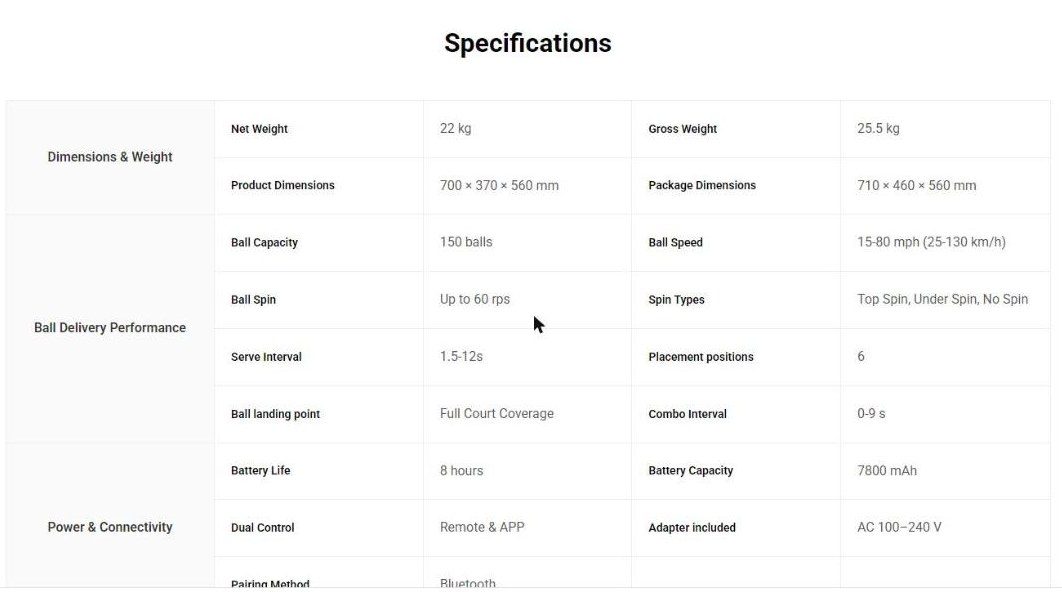
Both the Pace S and the Pace S Pro list 150 balls of capacity, 15 to 80 mph of ball speed (25 to 130 km/h), spin up to 60 rps, a 1.5 second spin switch, a serve interval of 1.5 to 12 seconds, a net weight of 22 kg, an 8 hour battery and the same Movement Tracking feature. On the published spec sheet there is no mechanical difference at all.
What the extra 220 US dollars buys, according to the two product pages, is software: 564+ preset drills on the Pro against 396+ on the Pace S, and the NTRP 1.0–7.0 Match Challenge mode, which the Pace S page does not list. That is 168 additional drills and one training mode.
Whether that is worth 22% more depends entirely on how you train. A player who works through structured drill libraries will use it; a player who sets one feed pattern and hits for an hour will not. The honest framing is that this is a software upgrade priced like a hardware one, and the store does not spell that out anywhere.
The full PONGBOT tennis ball machine specification sheet
The detail worth knowing beyond the headline numbers, taken from the Pace S Pro specification table, is the clearest published picture of what a full-size PONGBOT tennis ball machine does:
Dimensions and weight. 700 × 370 × 560 mm, 22 kg net and 25.5 kg gross. That is a machine you wheel to a court, not one you carry up stairs casually.
Ball delivery. 150 balls, 15–80 mph, up to 60 rps of spin, top spin, under spin and no spin, serve interval 1.5–12 seconds, combo interval 0–9 seconds, six placement positions and full court coverage.
Power and connectivity. 8 hour battery life from a 7800 mAh pack, remote and app dual control on every full-size PONGBOT tennis ball machine, Bluetooth pairing, and a 100–240 V adapter that will work on any mains supply worldwide.
In the box. The machine with one battery, two P Station S units, one P Tag S, a remote, an adapter and a cable. The Pace is also listed as compatible with clay, artificial grass, hard and natural grass courts, and optimised for padel.
One practical note on balls. A machine that fires 150 balls at 80 mph goes through pressureless balls rather than match balls, and the store sells them in 50 and 100 packs. If you want to understand which balls are approved for competition and why pressureless practice balls behave differently, the ITF publishes its ball approval procedures in full.
App control, tracking and what the hardware in the box does
Every full-size PONGBOT tennis ball machine ships with both a physical remote and app control over Bluetooth, which matters more than it sounds: a remote on your racket hand changes drills without walking to the baseline, and the app is where the preset drill libraries live.
The two P Station S units and the P Tag S listed in the box are the tracking side of the system. The Pace pages describe Movement Tracking built on these units, which is what lets the machine respond to where the player is rather than firing a fixed pattern. The company does not publish an accuracy figure for the tracking, so this review notes the feature without quantifying it.
On the Aura the same idea is taken further and described as an AI Coach, with a Match Challenge mode the page says recreates rallies from uploaded match footage. That is a company description of software behaviour, not something a desk review can verify, and it is the sort of claim worth testing in the 30-day return window rather than taking on trust.
Aura: the lightest PONGBOT tennis ball machine, with a catch
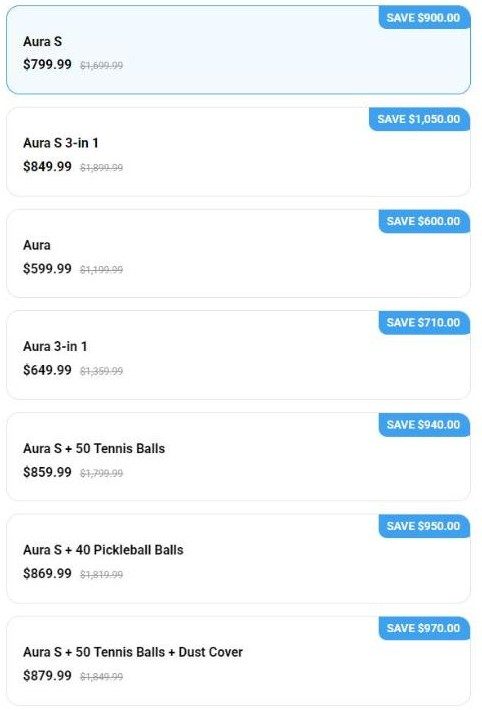
The Aura is the newest PONGBOT tennis ball machine and the most interesting one on paper: 7 kg against the Pace at 22 kg, marketed as the world’s first ultra-light AI multi-sport robot, with an AI Coach, a Match Challenge mode that recreates rallies from uploaded match footage, and support for tennis, pickleball and padel.
Here is the catch, and it is stated plainly on the page rather than hidden: “Choose 1 of 3 sports, additional sports require Sports Unlock Card.” A PONGBOT tennis ball machine sold as 3-in-1 ships configured for one sport.
The variant ladder shows exactly what that costs. The Aura is 599.99 US dollars and the Aura 3-in 1 is 649.99; the Aura S is 799.99 and the Aura S 3-in 1 is 849.99. So the full three-sport unlock is a flat 50 US dollars on either tier. That is a reasonable price for the capability and a confusing way to present it, and anyone buying an Aura for pickleball as well as tennis should pick the 3-in 1 variant at checkout rather than discovering the limitation afterwards.
The table tennis side, briefly
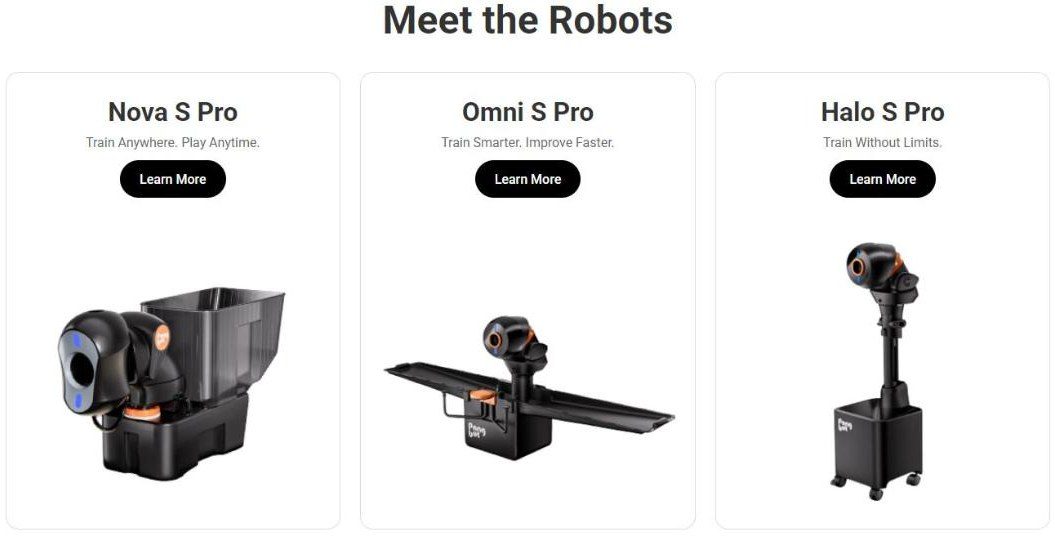
Three robots carry the table tennis line that sits beside the PONGBOT tennis ball machine range: the Nova S Pro at 299.99 US dollars, the Omni S Pro at 1,299.99 and the Halo S Pro at 1,599.99, with the Omni S Plus at 699.99 sitting alongside them. They hold 250 balls, weigh 9 to 11 kg, and the Halo S Pro publishes a ball speed of 2 to 15 m/s.
They are mentioned here only so you do not buy one by accident. A separate review of the Nova S Pro covers that side of the range properly; this article is about the PONGBOT tennis ball machine family.
Bundles, instalments and what ships in the box
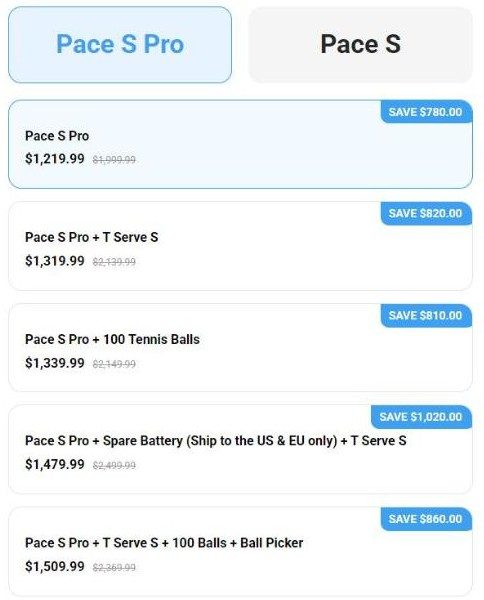
Each PONGBOT tennis ball machine is sold as a bare unit or in bundles, and the bundles are where the savings get larger in absolute terms. On the Pace S Pro the published options run from the machine alone at 1,219.99 US dollars up to the machine with a T Serve S, 100 balls and a ball picker at 1,509.99, with the store showing a saving of 860 US dollars against list on that combination.
The spare battery bundle is the one to look at if you play long sessions, at 1,479.99 with a T Serve S included, though the store notes that spare batteries ship to the US and EU only. Payment can be split into four interest-free instalments, which the Pace S Pro page quotes at 133.12 US dollars each.
Accessories, balls and spare parts
The accessories collection is where the running costs of a PONGBOT tennis ball machine sit, and it is worth a look before you commit to a model.
Pressureless practice balls are sold in 50 and 100 ball packs, which is the consumable you will actually re-buy; a hopper of 150 balls fired at 80 mph does not treat match balls kindly. The T Serve S and the ball picker are the two accessories that appear in almost every bundle, and the ball picker is the one that changes how long a solo session lasts.
Spare batteries carry the deepest accessory discount in the sale at 43% on the Pace pack, but the store notes they ship to the US and EU only. If you are outside those regions and you train for more than the published 8 hours between charges, that restriction is the one to check with support before ordering rather than after.
Warranty, returns and delivery
The service terms published on the store are better than average for this category, and they apply across the PONGBOT tennis ball machine line and are a real part of the value:
30-day hassle-free returns and exchanges, with the company stating it covers return costs for faulty or defective items. Up to a 3-year warranty on core components and general accessories. Free delivery in 3 to 7 business days across the US, EU, UK and Australia. Support by email at the published service address, advertised as 24/7.
Read the warranty wording carefully before you rely on it: “up to 3 years” is a ceiling that covers core components and general accessories, not a flat three-year term on everything, and the store does not publish the component-by-component breakdown on the homepage.
Which PONGBOT tennis ball machine fits which player
If you want the lightest machine and train more than one racket sport: the Aura at 7 kg, and buy the 3-in 1 variant so you are not locked to a single sport.
If you want full-size court performance at the lowest price: the Pace S at 999.99 US dollars, the cheapest full-size PONGBOT tennis ball machine on the site. Same hardware as the Pro by the published numbers, 396+ drills, and 220 dollars cheaper.
If you work through structured drill programmes or want the NTRP match mode: the Pace S Pro. Compare the two Pace models side by side on the product page before deciding, since the toggle there shows both specification sets.
If you are buying for a club or want the Australian Open edition: the AO Pace S Pro at 1,599.99 US dollars.
A PONGBOT tennis ball machine fits less well if you need to carry it up several flights of stairs regularly, since the Pace line is 22 kg, or if your budget is under 500 US dollars, since the cheapest tennis machine is 599.99.
How this PONGBOT tennis ball machine review was done
This is a desk review. Every price, specification and policy above was read from the public PONGBOT store, product pages and table tennis page in a browser on 22 October 2026, with the storefront currency confirmed as USD before any figure was recorded. No machine was bought, no machine was tested on court, and no performance claim is made.
Prices were cross-checked against the store’s own product data rather than read from marketing images, and the discount percentages in the table are this review’s own arithmetic from the sale and list prices, which anyone can repeat in a minute. Where the company’s banner and its product pages disagree, both are reported. Company statements about partnerships and about being the world’s number one AI-powered tennis machine are labelled as company claims because no independent verification is available.
Screenshots are of product and specification pages only; the customer and coach testimonial blocks on the site were deliberately excluded. Sale pricing on this store changes during the promotion window, so confirm the live figure at the PONGBOT store before you buy.
The short version
The PONGBOT tennis ball machine range is well documented, competitively priced during this sale, and every PONGBOT tennis ball machine is backed by 30-day returns, up to three years of warranty and free regional delivery. The Pace specification sheet is detailed enough to compare properly, the Aura at 7 kg genuinely solves the portability problem that puts people off ball machines, and the instalment option makes the four-figure models easier to approach.
Three things to check before you pay: the catalogue contains four table tennis robots that are not tennis machines; the 220 dollar gap between Pace S and Pace S Pro buys drills and a match mode rather than better hardware; and the Aura ships configured for one sport unless you pick the 3-in 1 variant for 50 dollars more. Add the 55 per cent banner against a 50 per cent best actual discount, and the rule is simple: buy from the product page, not the poster.
Overall: 8.7 / 10